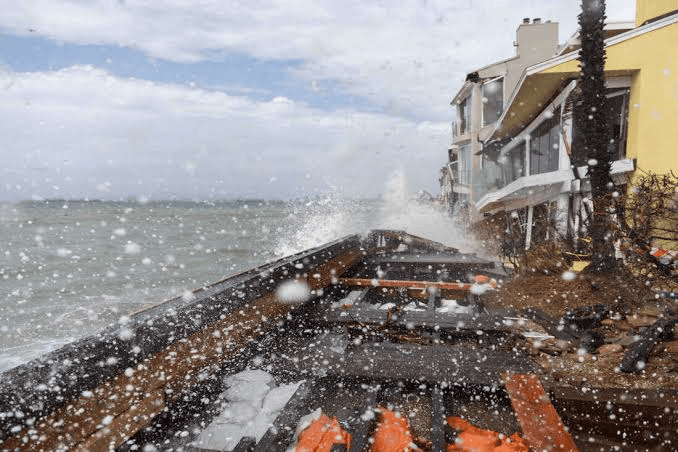
Hurricane Rachel reminded us of something: Mother Nature doesn’t care about your business plan.
One minute you’re running your business, serving customers, managing employees, and making moves. The next minute, you’re watching floodwaters rise, roads disappear, and entire communities struggle to recover.
As Hurricane Rachel moved through the Southwest, communities in California and neighboring states faced heavy rainfall, flash flooding, and coastal damage.
And while the headlines focus on flooded streets, damaged buildings, and emergency rescues, there’s another story that doesn’t always get told.
What happens to the small businesses after the water goes down?
The restaurant that can’t reopen.
The neighborhood grocery store that loses inventory.
The daycare that has to close for cleanup.
The trucking company whose vehicles can’t get through flooded roads.
The business owner who still has payroll, rent, and utilities to pay—even though revenue has stopped.
And here’s the kicker.
Even when businesses have insurance, getting back on their feet can take time.
But what if there were another way?
There’s a Different Kind of Insurance in Town
It’s called parametric insurance.
Now, don’t let the fancy name scare you. The concept is actually pretty straightforward.
Traditional insurance generally pays based on the amount of covered damage or loss you experience. That often means inspections, documentation, claims adjustments, and waiting for a settlement.
Parametric insurance works differently.
Instead of waiting to calculate every dollar of damage, a parametric policy pays a predetermined amount when a specific, measurable event occurs.
For example:
Imagine you own a small grocery store in a flood-prone neighborhood.
You purchase a parametric flood policy that provides a $50,000 payout if floodwater reaches a specified depth at your location.
If an eligible flood occurs and the independently measured water level reaches that threshold, the policy triggers the agreed-upon payment.
No traditional damage-adjustment process. No waiting for someone to calculate the value of every damaged item.
Just a payment based on the conditions established in your policy.
And depending on the product, that money could arrive within days after verification.
That’s a whole different conversation about insurance.
Because Your Business Doesn’t Stop Having Bills Just Because It Stops Having Customers
Here’s what I love about the concept of parametric insurance.
It’s not just about replacing what was damaged.
It’s about helping businesses access money when they need it most.
Depending on the policy, the payout could help with:
-
Employee payroll while operations are interrupted.
-
Temporary relocation or operating expenses.
-
Emergency cleanup and recovery costs.
-
Lost revenue and other financial consequences of a qualifying flood.
-
Keeping the lights on while the business gets back to business.
And in some policies, a business may receive a payment even without direct physical damage to its property, provided the agreed trigger and other policy conditions are met.
That’s important.
Because sometimes the flood doesn’t have to enter your building to hurt your business.
If customers can’t reach you, employees can’t get to work, or suppliers can’t deliver, you may still have a serious financial problem.
This Isn’t Some Future Insurance Concept. It’s Already Here.
Several companies are bringing parametric insurance solutions to the market.
FloodFlash uses water-level sensors installed at insured properties to measure flooding and determine when a predetermined payout should be triggered.
Floodbase uses satellite data and flood analytics to help insurers structure parametric flood protection. In 2026, Floodbase and Liberty Mutual announced an instant quoting solution designed to make parametric flood coverage more accessible in the U.S. commercial market.
Descartes Underwriting offers parametric flood solutions using technologies such as water-level sensors, river gauges, and rainfall measurements, depending on the product.
These companies are helping change how businesses think about insurance—from simply repairing damage to providing faster financial resources following a disaster.
And that matters for small businesses that may not have months of operating cash sitting in the bank.
But Don’t Throw Away Your Traditional Insurance Policy
Let’s be clear.
Parametric insurance isn’t necessarily a replacement for traditional property or flood insurance.
Think of it as another tool in your financial protection strategy.
Traditional flood insurance can help repair or replace covered property.
Parametric insurance can provide additional liquidity when a qualifying event occurs.
And there’s a catch worth understanding: if the specified trigger isn’t reached, the parametric policy generally won’t pay—even if your business experiences a loss.
That’s why the trigger, payout amount, coverage terms, and relationship to your existing insurance all matter.
The goal isn’t to buy another policy just because it’s innovative.
The goal is to build a protection strategy that actually works for your business.
The Next Flood Isn’t Waiting for You to Get Ready
Hurricane Rachel is another reminder that flooding isn’t just a coastal problem. Heavy rainfall, overflowing waterways, and flash floods can disrupt businesses far from the beach.
And while we can’t control the weather, we can control how prepared we are financially.
At AKO Brokerage Services, we believe small-business owners deserve access to more than the same old insurance conversation.
That means introducing innovative solutions, asking better questions, and helping business owners understand how emerging insurance products can support their long-term resilience.
Because when the water rises, your business shouldn’t automatically go under with it.
Let’s Talk About Your Flood Risk
Does your business have flood coverage? Would your current insurance help replace lost revenue? Could your business survive several weeks without customers?
And have you considered whether parametric insurance might fit into your protection strategy?
Connect with Ako Brokerage Services. Let’s explore your options and make sure you’re not just insured—you’re better prepared for what comes next.
Parametric coverage, eligibility, triggers, payment timelines, and availability vary by provider and policy. Examples are illustrative and do not represent guaranteed coverage or payouts.